What ISPA’s Snapshot Survey reveals about spa strategy, value and margin protections.
PRICING HAS ALWAYS BEEN A BUSINESS LEVER, but ISPA’s May 2026 Snapshot Survey on pricing and promotional strategies suggests spa leaders are approaching it with new urgency. Sponsored by Eminence Organic Skin Care, the survey gathered input from 288 spa industry professionals and points to a market balancing guest trust, rate consistency and rising cost pressures. As margins tighten, spa leaders are being pushed to think beyond isolated price changes and toward pricing architecture as part of the broader guest, revenue and brand strategy.
EXECUTIVE SUMMARY: Spa Members Highlights
SPA LEADERS INSIGHT
Compare your pricing structure against your utilization patterns. If certain days or providers are consistently full, those areas may warrant a pricing review before additional marketing dollars are spent to drive demand.
STABILITY STILL MATTERS, BUT STATIC PRICING HAS LIMITS
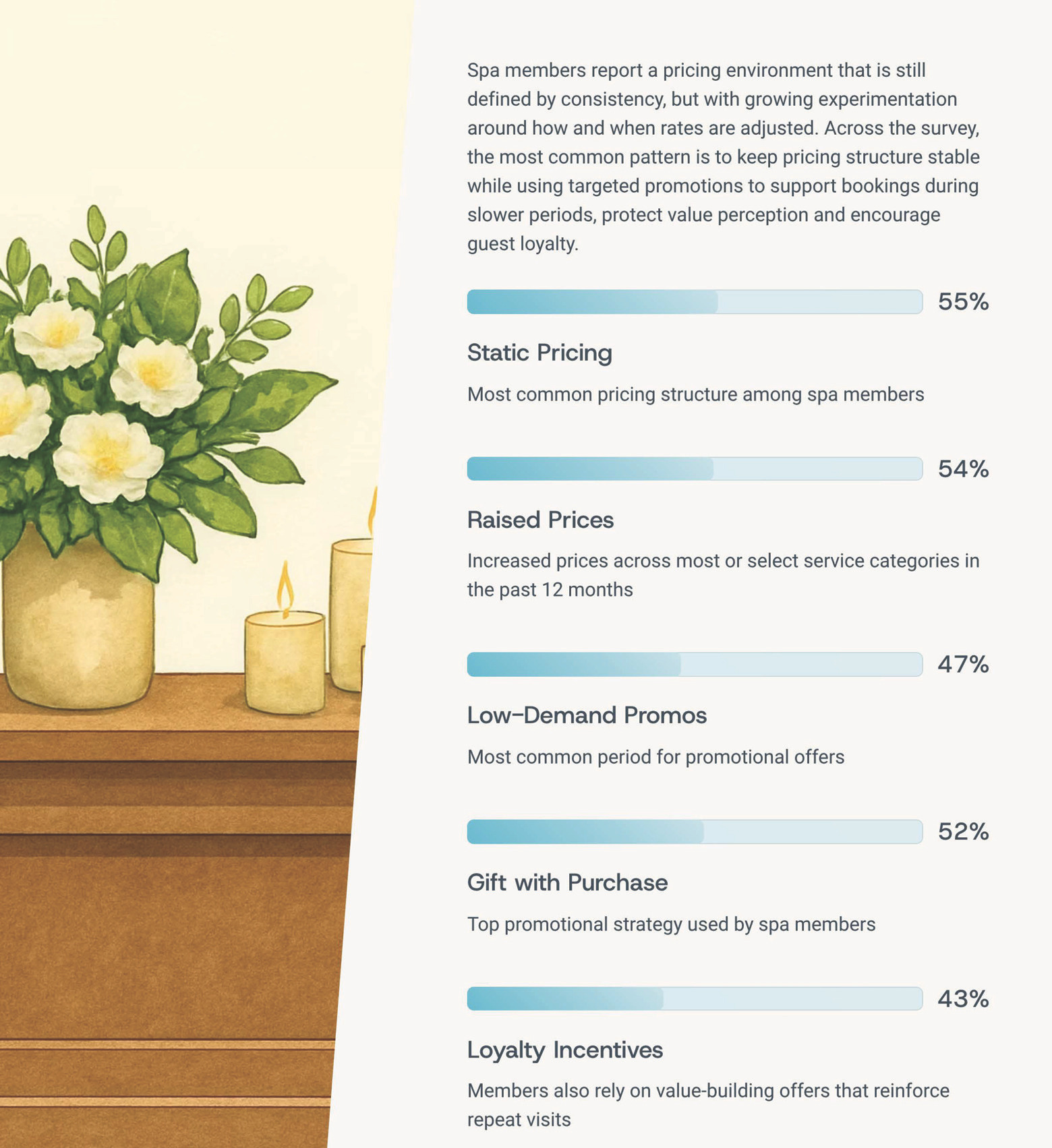
Static pricing remains the dominant model among spa members, with 55 percent relying on consistent service prices. Predictable pricing is easy for guests to understand, simple for teams to explain and consistent with the trust-driven nature of spa experiences.
But consistency can come at a cost. When every time slot, provider, season and demand window is priced the same, spas may be leaving revenue on the table during peak periods while overusing promotions during slower ones. Nearly one-third use variable pricing, 27 percent use package or bundled pricing, 25 percent use member or loyalty-based pricing and a quarter report using dynamic pricing.
The takeaway is not that every spa should adopt complex revenue management. Rather, leaders should consider whether their pricing model reflects how demand actually behaves. A fully static menu may feel simple, but it can limit a spa’s ability to capture peak demand, direct guests toward softer periods and protect margins.
Menu pricing adjustments in the past 12 months
Spas were asked whether they had adjusted menu pricing within the past year. This single-response question reveals the industry’s recent pricing momentum and shows how broadly pricing decisions are being used to respond to changing business conditions. For many operators, price changes are no longer limited to a single annual update — they are increasingly being used as a practical lever to protect margins, match market conditions and keep menus aligned with costs.
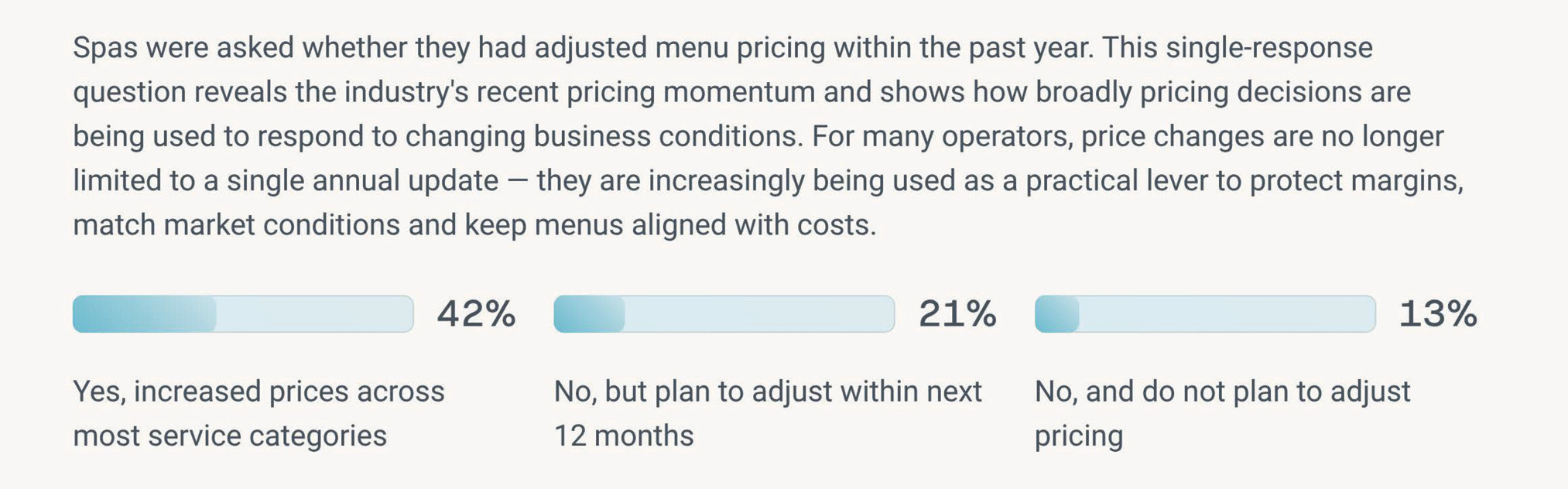
Two-thirds of spa respondents reported changing prices in the past year, while another 21 percent plan to do so within the next 12 months. Only 13 percent said they had not adjusted prices and did not plan to.

That signals a shift in leadership behavior. Pricing is no longer a once-in-a-while menu update, but a recurring discipline tied to cost control, competitive positioning, service mix and margin protection. The challenge is execution. Guest resistance was the top pricing concern, cited by 27 percent of spa respondents. Other barriers included discounts reducing profitability, difficulty communicating changes, software limitations, brand perception and team consistency.
THE LEADERSHIP TAKEAWAY: Build a pricing system, not just the price list
The survey’s clearest message is that pricing and promotions are becoming more intentional across the spa industry. Spas are protecting consistency while testing targeted flexibility, raising prices while managing guest perception and using value-added offers to preserve margins.
For spa business leaders, the opportunity is to move from reactive pricing to a structured system—one built around regular menu reviews, demand analysis, cost tracking, staff communication and clear alignment with brand positioning.
Promotion Planning Questions
Responses to ISPA’s Snapshot Survey suggest spas are becoming more disciplined about when and how they promote. Offers are most commonly used during low-demand periods, weekdays and other softer windows, while only five percent of respondents promote on weekends—a sign many spas are avoiding discounts when demand is already strong. The strongest promotions solve a specific business problem, such as filling unused capacity, encouraging trial, increasing retail attachment or driving repeat visits. They also create value rather than simply reducing price.
Before launching a discount or value-add, ask:
- What business problem are we solving?
- Is the goal occupancy, trial, loyalty, retail sales or average ticket?
- Will this offer protect—or dilute—our perceived value?
- How will we measure success?
- Does the team know how to explain it clearly?
THE FULL REPORT: ISPA members can download the full Pricing & Promotional Strategies Snapshot Survey in the Research tab at experienceispa.com. Use the report as a benchmarking tool for your next leadership discussion on pricing, promotions, margins and guest value.
Behind the Report: How ISPA Is Using AI to Work Smarter
The May 2026 ISPA Snapshot Survey report on pricing and promotional strategies marked a new step in how ISPA presents research to members. For this edition, ISPA used an AI-assisted tool to support report presentation and design, helping transform survey findings into a more visual, accessible and easy-to-navigate format.
The intelligence behind the insights, however, still came from people. The survey data came directly from ISPA member spas and resource partners, and the report’s analysis, development and final review were overseen by ISPA staff. AI did not create the data or replace human judgment. Instead, it served as a production and presentation tool—one that helped improve efficiency, clarity and speed.
This may feel familiar for spa leaders: AI is not a substitute for expertise, but it can be a useful partner in organizing information, improving workflows and helping teams communicate more effectively.
PRICING WITH PURPOSE — RETAIL RESET
Supporting Guests Through Weight-Loss Changes
AS GLP-1 USE AND MEDICAL WEIGHT LOSS PROGRAMS BECOME MORE COMMON, spas may have an opportunity to rethink how their retail shelves support guests experiencing visible body changes and evolving self-care needs.
The goal is not to make medical claims or position spa team members as health advisers. It is to recognize changing guest concerns and offer thoughtful, well-vetted products that support comfort, confidence and everyday care.
RETAIL TRENDS TO WATCH:
- Apparel sizing may be shifting. Some spa leaders are seeing stronger movement in smaller apparel sizes, while larger sizes are selling more slowly. Consider reviewing size runs, sell-through patterns and reorder strategies to better align with changing guest demand.
- Hair and scalp wellness are on the rise. Guests experiencing shedding or changes in hair fullness may be looking for scalp treatments, scalp serums, gentle hair care and massage tools.
- Skin elasticity is a growing focus. Collagen-supportive products, firming body care and body oils may appeal to guests looking to support changing skin.
- Dry skin support matters. Rich moisturizers, barrier-repair formulas, hydrating masks and nourishing body creams can help guests maintain comfort and confidence.
- Supplements require care. Vitamins, collagen powders and beauty-from-within products may be worth exploring, but claims should be carefully reviewed and staff should avoid offering medical advice.
MERCHANDISE AROUND THE NEED
Rather than creating a display centered specifically on GLP-1 medications, consider organizing products around a broader message: Skin, scalp and self-care through body changes. This approach can feel more welcoming, more inclusive and much more spa-like.
ON MEMBERS’ MINDS: GLP-1 medications and medical weight-loss programs were not a primary focus of ISPA’s May 2026 Snapshot Survey. Yet references in members’ open comments suggest the subject is entering the spa business conversation.
Some respondents pointed to changes in apparel sales and growing guest interest in products that support the skin, scalp and body during significant weight loss. While these comments do not represent a quantitative survey finding, they offer an emerging business signal worth watching.

Consider gently curating displays and product recommendations that focus on comfort, fit and gentle care rather than medical positioning. Thoughtful signage and staff training will help guests find the right products without creating unrealistic expectations.